
In a new series of nice things, Ruari, Sticky's Design Lead, has been given the task of choosing awesome designers and inspirational design work that gets us thinking. Here he's chosen designer and inventor Tom Lawton and probes to find out more about his work, his process, and his latest masterpiece, Uplift.
Ready? Right, here we go...

Ruari: Congratulations with the success of Uplift 2.0, it's a beautiful piece. How has the journey been for you since your initial idea?
Tom: Thank you so much. Uplift started about three years ago as an experimental art piece, so it's come a long way to reach the point where we are building them every day, using advanced manufacturing and selling to customers all around the globe. My fledgling business has taken root in a pandemic, so it's been a challenging year or two but, wow, the feedback makes it so worthwhile - people seem to LOVE them, which makes the hard work so worthwhile. I have trusted my intuition entirely with this project and it's now a business that I hope will continue to grow.
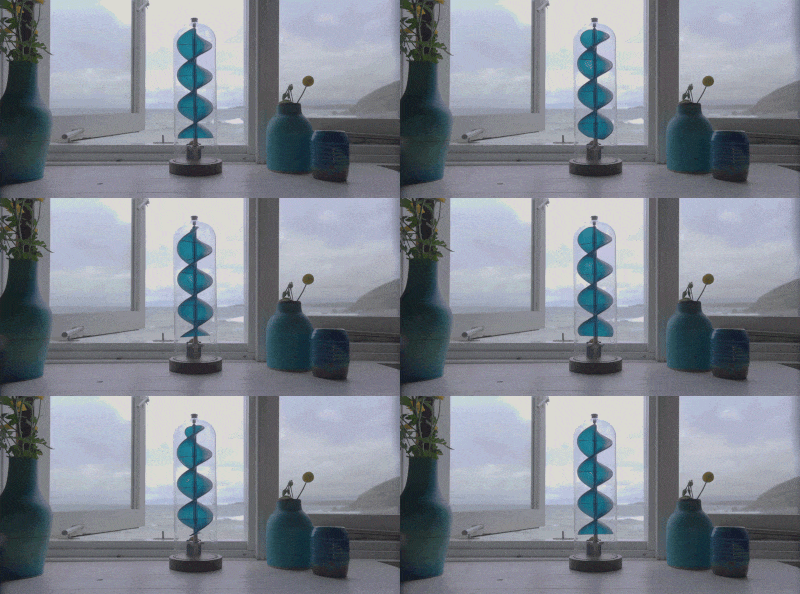
Ruari: You've used Cornish fishing nets - what's your connection there?
Tom: I'm a west country boy so I've always had a close relationship with Cornwall, but really, I live in landlocked Wiltshire, so the connection is the same as most Brits - Cornwall is a lovely place to visit. I used to make each Uplift from a stacked spiral of walnut, and I asked my customers what they wanted to see next. The response was unanimous, everyone wanted something reminiscent of ocean waves, so I headed to the coast in search of inspiration. When I got to the beach, I found the rocks littered with marine plastics and so we were inspired to explore the use of waste fishing nets. We take nets from landfill and so we're part of the solution to a very real problem. So far we have saved the equivalent of 20 tons of Co2 compared to using virgin plastic - and the result is exquisite.
Ruari: How many prototypes did you create and what was the hardest part to get perfect?
Tom: Goodness, lots - always so many. In a way all 450 units of my first batch were prototypes as each was hand built and individually calibrated. I am not a perfectionist when it comes to my personal life but when it comes to my products, I am in pursuit of nothing but perfection and that takes some refining. The hardest thing was getting each one to be self-start - so that every customer has an uplifting experience from the get-go. That means overcoming lots of challenges - there's a lot of difference between the sun on a windowsill in Dubai and one in Stockholm - and each uplift needs to be able to overcome that difference and still create the same gentle motion. As simple as the design appears each unit is like a finely tuned engine so there were a lot of fine details that needed to be ironed out and mainly those were in the tolerances of parts and materials. Fortunately, I have 25 years' experience as an inventor so most mistakes I have already made in my career.
Ruari: Along with Uplift, what is the invention you've been most proud?
Tom: I am proud of all my work, of all my inventions. Each one tells a story of the time and experiences I was having. In 2001 I was inspired by the limitation of conventional photography to create a camera called BubbleScope that could capture the world in 360 degrees. In 2009 I won the biggest green design award in America with a design called Firewinder that turned the wind into light. I made a boat called Necessity filled with innovations for Channel 4. Million Mile Light helps keep tens of thousands of runners safe in the dark by turning their motion in to light. Everything I've invented has been done so with the best of intentions and that's all you can really do. I've not made anything world changing yet but I've given it a go. You can discover my work over 20 years x 20 slides x 20 seconds here and at https://vimeo.com/506040540
Ruari: Is simplicity of product designing one of the most difficult or easy parts of the process?
Tom: There is certainly an art to achieving simplicity in product design. It's a bit like sculpture - you start of solving a problem in a crude way e.g. prototyping and then you refine the design in to solve whatever problem it overcomes in a way that feels right. As for process, I like to take time to test ideas with real world feedback.
Ruari: How did you first get interested in Magnetism as an energy source?
Tom: I bought a make your own wind turbine kit in around 2005. I just began to play with it. I like the magical way that the movement of coil wire relative to a magnetic field creates electricity. We owe it all to Michael Faraday, of course, but new technologies mean more and more can be achieved. As for harnessing energy, that'd my interest, be it human, the wind or sun, I like using each to do cool things.

Ruari: As a designer and inventor, you have to have a multitude of skills and knowledge including business, marketing, design and prototype construction. What's the hardest part?
Tom: Some things come naturally, some don't. I fortunately now have an excellent and experienced business partner at Uplifting Products who looks after our finances and other vital aspects of the business. Historically, cash flow has always been the hardest part - R&D on a budget forces you to take an essential path. Keeping on top of customer relations simply due to the multitude of ways you can be reached these days so I long for an assistant.
Ruari: What was the biggest Eureka moment when designing and creating Uplift?
Tom: There were two moments, the first was when my wife Charlie came home and zoned out for fifteen minutes looking at an early uplift prototype on the windowsill and remarking that she couldn't remember what she'd been thinking about - it had instantly bewitched her. The second was when I showed it to my Gran who had dementia and she enjoyed a similar effect. These moments inspired me to make it a real thing.
You can watch The Uplift Story here and at https://vimeo.com/461363954
Ruari: In your opinion, how should a good design process begin?
Tom: That's a good question. With the humble premise of asking whether this a problem that really needs to be solved? Is there another way e.g. changing a behaviour to negate the problem - sometimes design can achieve that, sometimes the world needs less design.
Ruari: Uplift feels beautifully simplistic and represents the classic form-follows-function approach. Are there other designs or designers you admire for that approach?
Tom: I follow a few accounts on instagram of designers who produce beautiful forms, often as conceptual renders, and I follow people who curate classic designs from yesteryear, including graphics, art and motion picture design - I think across all this I pick up loads of inspiration but not any particular names no, you just recognise good design.

Ruari: To date, what have been the biggest challenges for you as a designer?
Tom: Easily finance. I've become pretty proficient at running crowd fund campaigns but before the advent of platforms like Kickstarter it was pretty impossible to do this - it's still hard but Uplift is very popular which is great - so all focus is on that.
Ruari: As a graphic designer, I can't help but admire your handmade logo. It's refreshing to see. How did that come to life?
Tom: Oh thanks, it kind of drew itself if that makes sense. I was just doodling, and you know, a few pages in and I drew it a bit more nicely. Then I had a friend who made a lino cut stamp for me and he literally cut it by hand, and we stamped it. Then I took a photo and crudely traced it in the computer. I like that it's been created that way, again, it has a nice feel to it.

Ruari: What's next on your design To-Do list?
Tom: I am currently planning to install Wonder at Malmesbury Abbey, and for the immediate future - grow Wonder alongside Uplift and lift people's spirits with good design. It's the most amazing creation and it will be fascinating to see where it grows. The kickstarter video is below:
Thanks for your time, Tom. It's exciting to discover and discuss good design...


